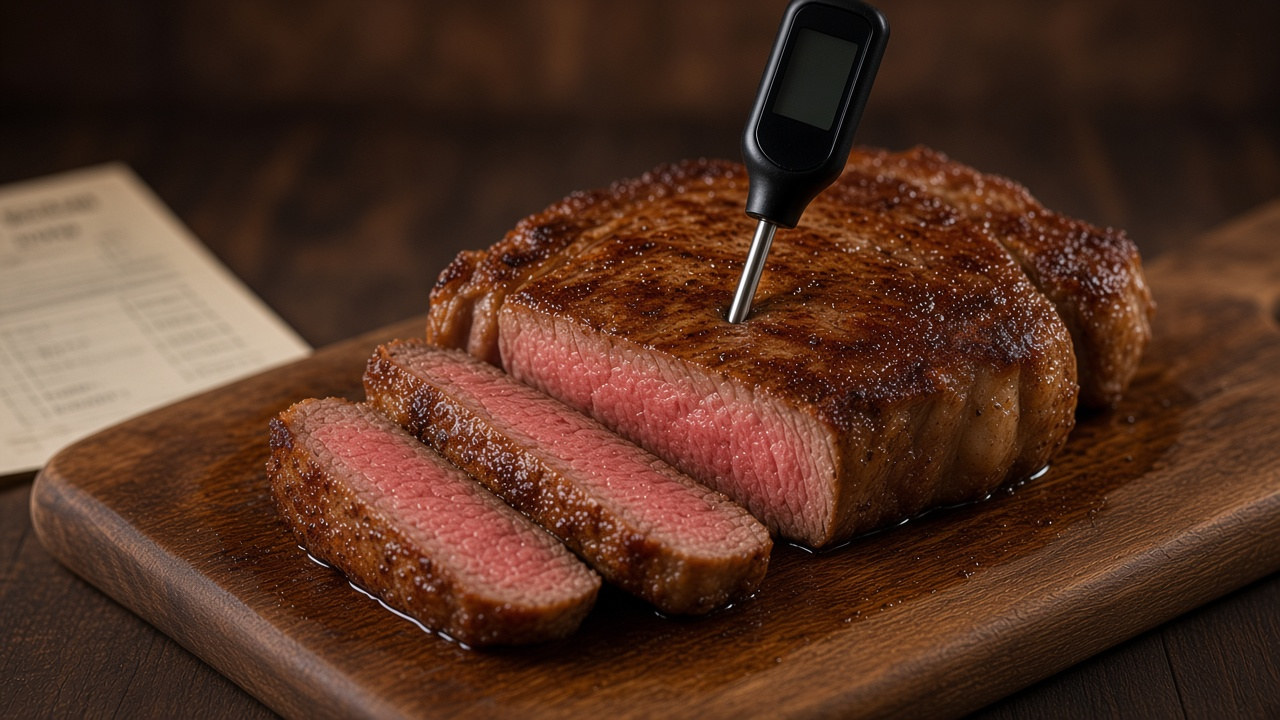
Most of the time you don't need a long article about food safety. You need one number, quickly, while the pan is hot. This page is that number for the foods most home kitchens cook, in one chart you can print and stick on the fridge.
You don't need to buy anything to use it. If you already own a food thermometer, this is the cheat sheet that goes with it. If you don't, the chart still tells you what the target is.
The cheat sheet
From FoodSafety.gov's Safe Minimum Internal Temperature Chart (date last reviewed November 21, 2024), checked November 12, 2026. Measure in the thickest part of the food with a food thermometer.
| Food | Safe minimum | Rest time |
|---|---|---|
| Chicken, turkey and all other poultry: whole, pieces, ground, giblets and stuffing inside the bird | 165°F (74°C) | Not required |
| Ground beef, pork, veal and lamb, and sausage | 160°F (71°C) | Not required |
| Beef, bison, veal, goat and lamb steaks, roasts and chops | 145°F (63°C) | 3 minutes |
| Pork steaks, roasts and chops | 145°F (63°C) | 3 minutes |
| Raw ham (fresh or smoked) | 145°F (63°C) | 3 minutes |
| Precooked ham, reheated | 165°F (74°C); 140°F (60°C) if packaged in a USDA-inspected plant | Not required |
| Rabbit and venison | 160°F (71°C) | Not required |
| Fish, whole or fillet | 145°F (63°C), or until the flesh is no longer translucent and separates easily with a fork | Not required |
| Shrimp, lobster, crab and scallops | Cook until the flesh is pearly or white, and opaque | Not required |
| Clams, oysters and mussels | Cook until the shells open | Not required |
| Egg dishes such as frittata and quiche | 160°F (71°C) | Not required |
| Casseroles, with or without meat | 165°F (74°C) | Not required |
| Leftovers, any type | 165°F (74°C) | Not required |
Printing tip: this page prints without the menu, photo and sidebar, so the chart fits on a sheet of paper.
Color is a poor guide. The number on the thermometer is the one that counts.
Why ground meat needs a higher number than a steak
On a whole steak or roast, any bacteria present sit mostly on the outside, and the outside gets far hotter than the center while it cooks. Grinding changes that. USDA's Food Safety and Inspection Service explains that when meat is ground, more of its surface is exposed and any bacteria on the surface get mixed all the way through. The middle of a burger can carry the same germs as the outside, so the whole patty has to reach 160°F.
That's why a steak can be safe at 145°F with a pink center while a burger cooked to the same point is not. The same goes for sausage and meatballs. Poultry is simpler: whole, in pieces or ground, the number is 165°F.
Resting time, in plain terms
Whole cuts of beef, pork, lamb and veal, plus raw ham, come with a 3-minute rest. FoodSafety.gov explains that the rest lets the innermost parts and juices finish cooking safely. Take the meat off the heat when it reads 145°F, set it on a plate or board, and wait three minutes before you cut or serve it.
For those cuts, the rest is part of the safety step, not just a chef's habit. Ground meat, poultry, casseroles and leftovers don't list a rest time; they simply need to reach their number.
These are minimums. You can cook anything hotter if you prefer it that way; many people like chicken thighs well past 165°F for texture. Just don't go lower.
Leftovers and reheating
From FSIS's Leftovers and Food Safety page (last updated July 31, 2020), checked November 12, 2026.
- Reheat leftovers to 165°F. Check the thickest part, and more than one spot in a big dish.
- Bring sauces, soups and gravies to a rolling boil. That's FSIS's rule for liquids instead of a thermometer reading.
- Microwaves heat unevenly. Cover the dish, stir or rotate it, let it stand a minute, then check the temperature in several places.
- Refrigerate within 2 hours. Make it 1 hour if it's above 90°F, such as at a summer picnic.
- Cool big batches fast. Split a large pot of soup or chili into shallow containers instead of chilling it in the pot.
- Use within 3 to 4 days, or freeze. FSIS says frozen leftovers stay safe but lose quality over time, and suggests 3 to 4 months for best quality.
The danger zone
FSIS describes 40°F to 140°F as the range where bacteria grow fastest. Keep cold food at 40°F or below, keep hot food at 140°F or above until it's served, and don't leave perishable food sitting out longer than 2 hours.
Where to put the thermometer
Short version: the thickest part of the food, away from bone, fat and gristle. For thin burgers and chops, slide the probe in from the side. On a whole bird, check the thickest part of the breast and the inner thigh. If two spots disagree, go by the lower reading. The meat thermometer guide covers this in more detail, along with an ice-water accuracy check.
The bottom line
Print the chart, put it where you cook, and let a thermometer settle the question. Four numbers cover most weeknights: 165°F for poultry and leftovers, 160°F for ground meat, 145°F plus a 3-minute rest for whole cuts and pork, and 145°F for fish. If the official chart changes, this page should change too, and the date above the chart says when it was last checked.