Amazon does not sponsor or endorse this site, and every recommendation here is my own. Product links on this page go to Amazon.com and are not affiliate links right now.
If your kitchen scale has started giving numbers you don't trust, the fix usually isn't a new scale. Most of the time it's the batteries, the surface the scale is sitting on, or a zeroing habit. This guide walks through the free checks first, using things already in your house, and only gets to replacing it at the very end.
If you don't own a scale yet and want to know whether you need one, start with why a kitchen scale beats measuring cups instead.
Start here: replace the batteries
Weak batteries are the most common cause of odd readings. A scale running low can drift, flicker, show different numbers for the same thing, or shut off early, sometimes before any low-battery symbol appears. Batteries are cheap, so rule them out first. Put in a fresh set of the type your manual lists, wipe the contacts if they look dull or crusty, and then run the checks below. If the problem goes away, you're done.
Set up for a fair test
- Use a hard, level counterNot a towel, a cutting board, a mat or the seam between two surfaces. A scale that rocks even slightly can read wrong.
- Check the feetA crumb or a dried drip under one foot tilts the platform. Turn the scale over and look.
- Let it reach room temperatureIf it lives in a cold cabinet or next to the oven, give it a few minutes on the counter first.
- Turn it on empty and wait for zeroFor this test, don't press tare with anything on it. You want to see the scale find zero on its own.
- Check the unitsA scale accidentally set to ounces or milliliters can look wrong when it's actually right.
Most people with a doubtful scale don't need a new one. They need new batteries and a level counter.
The nickel test
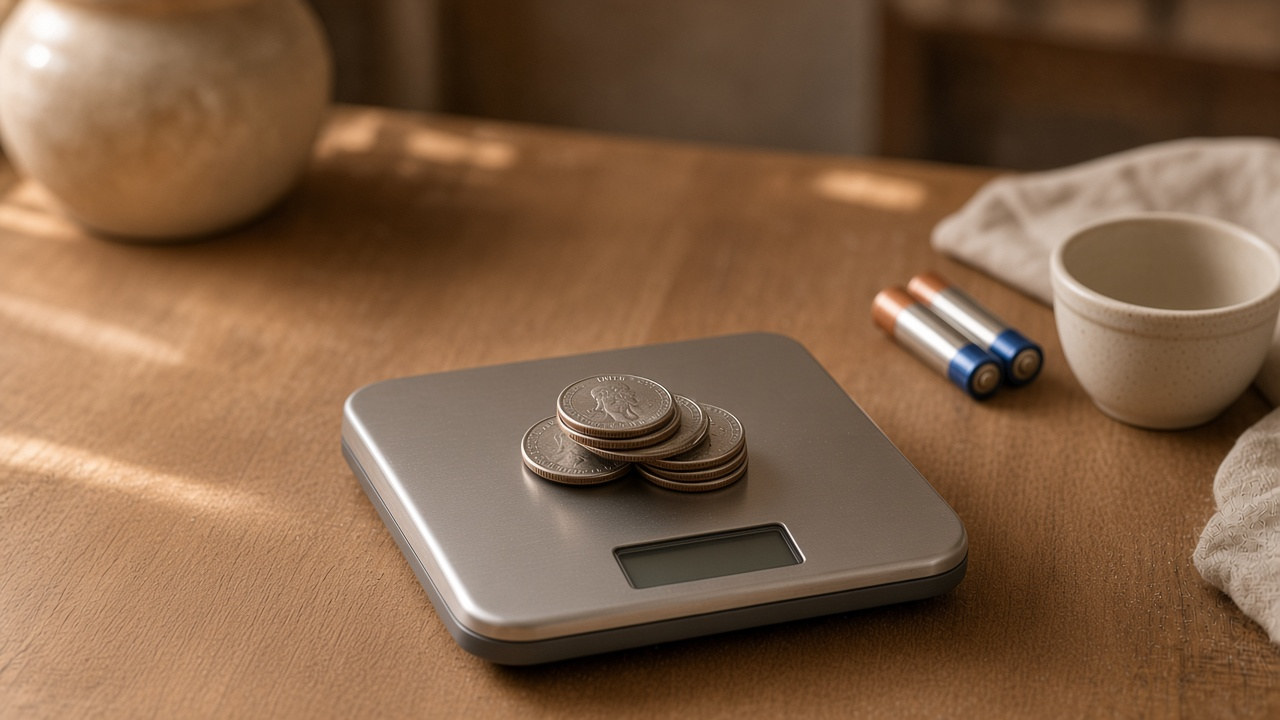
A US nickel is about the closest thing to a free test weight most kitchens have. The U.S. Mint lists the nickel's weight as 5.000 grams, and federal law (31 U.S.C. § 5112) specifies a 5-cent coin that weighs 5 grams. Coins wear a little in circulation, so use several rather than one; small differences even out.
- Gather 10 nickelsOlder coins are fine. Skip any that are sticky or dirty.
- Weigh them togetherTen nickels should read about 50 g. Twenty should read about 100 g.
- Repeat three timesLift them off, let the scale return to zero, and set them down again. The readings should match each other.
- CompareWithin a gram or two of the target is fine for cooking. A steady reading a few grams off can be noted and allowed for. Jumpy readings point back to batteries, the surface or a failing sensor.
Three more free checks
- The corner test. Note the reading with the nickels in the center, then try each corner of the platform. A healthy scale reads the same, or within about a gram, wherever the weight sits. Big differences by position usually mean a damaged sensor or a cracked platform.
- The return-to-zero test. Weigh something, take it off, and watch the display. It should go back to 0. If it settles at 1 or 2 g, or creeps over a minute, re-zero and test again.
- The water check (rough). One milliliter of water weighs about one gram. Tare an empty measuring cup, fill it to a marked line, and see if the grams roughly match. This tests the cup's markings as much as the scale, so a small mismatch is normal. It's useful for spotting a scale that's far off at heavier weights.
Habits that keep readings honest
- Tare with the bowl on, every time. Press tare after the bowl is on and again before each new ingredient.
- Watch the auto-off timer. If the scale shuts off mid-recipe with a bowl on it, it can wake up with the wrong zero. Lift the bowl, turn it back on, and re-tare.
- Don't store anything on it. Pans stacked on the platform strain the sensor over time.
- Keep it dry and away from heat. Wipe it rather than rinse it unless it's labeled waterproof, and don't keep it next to the stove.
- Use the right scale for tiny amounts. A scale that reads in whole grams can't tell 2 g of yeast from 2.4 g. For small amounts, a 0.1 g pocket scale is the right tool.
Signs it's actually time to replace it
After fresh batteries, a level counter and the nickel test, a scale is probably worn out if:
- The same nickels give readings that jump around by several grams.
- It won't return to zero, or settles on a different zero each time.
- The number changes depending on where the weight sits.
- The display is fading or missing segments even with new batteries.
- It got wet inside, or the platform is cracked or loose.
If none of those apply, keep using the scale you have.
 If you need one
If you do need a replacement: Etekcity Food Kitchen Scale
If your scale failed the checks above, the Etekcity Food Kitchen Scale (model EK6015) is a simple, long-established replacement and the same scale suggested in the main scale guide. According to the listing, it weighs up to 11 lb (5 kg) in 1-gram steps, switches between five units, has a tare button and a backlit display, and has a 304 stainless steel top. It runs on two AAA batteries, which come included, and the listing shows a 2-year warranty.
Etekcity Food Kitchen Scale
Check the current price on AmazonThe bottom line
Before you buy a new scale, spend two minutes and a handful of nickels. Fresh batteries and a level counter fix most problems. If ten nickels read about 50 grams three times in a row, your scale is fine for cooking.